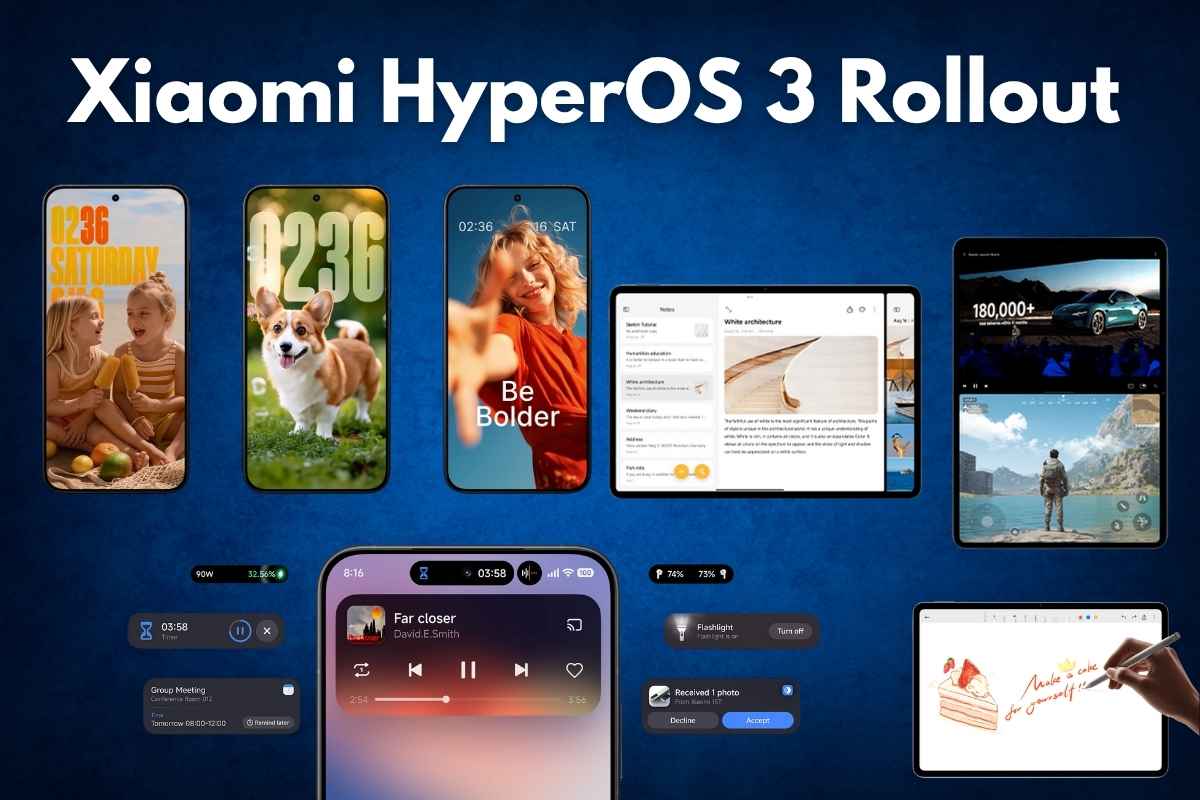
Xiaomi is accelerating its next major software update, Xiaomi HyperOS 3 Rollout built on Android 15 and now also on Android 16 for selected global models focusing heavily on performance, AI features, privacy, and ecosystem integration.
The company has already begun internal testing across multiple Xiaomi, Redmi, and POCO smartphones, while a wider stable update rollout has kicked off for global devices such as the Redmi Note 14 Pro 5G, Poco X7, and Poco X7 Pro.
HyperOS 3 Internal Testing Devices
Xiaomi has started closed internal testing for HyperOS 3 on the following Android 15-Based devices:
- Xiaomi 13 Lite / Xiaomi Civi 2
- POCO F5 Pro / Redmi K60
- POCO X6 Neo / Redmi Note 13 5G / Redmi Note 13R Pro
- Xiaomi MIX Fold 2
- Redmi Note 12T Pro
- Xiaomi Pad 6 Pro
- Xiaomi 12T Pro / Redmi K50 Ultra
- Xiaomi Civi 3
- Xiaomi 12 Pro
- Xiaomi 12S Ultra
- Xiaomi 12
- Redmi K60 Pro
These internal test builds confirm that Android 15-based HyperOS 3 stable version may arrive in late 2025.
Xiaomi HyperOS 3 Global Rollout
Xiaomi has now begun rolling out Android 16-based HyperOS 3 stable updates to several global models. This includes:
- Redmi Note 14 Pro 5G – build OS3.0.4.0.WOOMIXM
- Poco X7 Pro – build OS3.0.1.0.WNLMIXM
- Poco X7
The update ~6.5GB in size, so users should download it over Wi-Fi.
You can check manually via:
Settings → About Phone → System Updates
HyperOS 3: Updated Device List (Global Stable)
So far, the following global devices have received HyperOS 3:
- Xiaomi 15 Ultra
- Xiaomi 15
- Xiaomi Pad 7 Pro
- Xiaomi Pad 7
- Poco F7 Ultra
- Xiaomi 15T
- Xiaomi 15T Pro
- Redmi Note 14 Pro Plus 5G
- Redmi Note 14 Pro 5G
- Poco X7 Pro
- Poco X7
Scheduled for late November 2025:
- Redmi Note 14 4G
- Redmi Note 14 Pro 4G
- Xiaomi MIX Flip
What’s New in HyperOS 3 (Android 15 & Android 16 Features)
HyperOS 3 is designed as a unified OS for Xiaomi phones, tablets, and IoT devices. It brings several major upgrades:
Smoother UI & Improved Performance
- Optimized animations for a more fluid interface
- Faster app opening times
- Better RAM management
- Adaptive resources for gaming & heavy apps
These improvements make even mid-range phones feel faster.
Better Multitasking Tools
- Enhanced split-screen
- New floating app windows
- Smart app switching
- Priority background management
This is especially useful on tablets like Xiaomi Pad 6 Pro & Pad 7 series.
AI-Powered System Tools (New Additions)
HyperOS 3 brings a strong push for on-device AI:
- AI writing assistant
- AI summarization
- Real-time translation & transcription
- Smarter Gallery with object recognition
- Adaptive battery & performance suggestions
On supported devices, deeper Google Gemini integration improves AI tasks.
New Xiaomi Ecosystem Features
HyperOS 3 enhances cross-device functionality with:
- Touch-to-share (AirDrop-style sharing for select models)
- Seamless tablet-to-phone handoff
- Faster IoT pairing
- Unified control center for Xiaomi smart home devices
This makes the Xiaomi ecosystem more like Apple’s continuity features.
Enhanced Privacy & Security
Xiaomi adds multiple new system-level protections:
- Advanced Protection Mode
- Stronger app permissions
- Threat detection
- Trade-in Mode for safely preparing a phone for resale
The focus is on reducing data leakage and increasing transparency.
Redesigned Lockscreen & Homescreen
HyperOS 3 includes:
- iPhone-style HyperIsland UI elements
- More lockscreen customization
- New widget styles
- Cleaner homescreen layout
These changes give Xiaomi devices a more modern and premium feel.
Why HyperOS 3 Matters for Xiaomi Users
HyperOS 3 is a major step toward Xiaomi’s goal of building a single, deeply connected ecosystem like Apple and Samsung.
Key reasons it matters:
- First update integrating both Android 15 & Android 16 features
- Larger push for AI-powered tools
- Unified UI for phones, tablets, and smart devices
- Boosted performance for older Xiaomi & Redmi models
It positions Xiaomi strongly for the 2025–2026 flagship cycle.
Conclusion
Xiaomi’s HyperOS 3 update is one of the biggest upgrades the brand has ever released. With major improvements in performance, privacy, fluidity, multitasking, and AI capabilities, the update will significantly enhance user experience across both flagship and mid-range devices.
As internal testing continues and global rollouts expand, more Xiaomi, Redmi, and POCO users will receive the update over the next few months. If you own a 2023–2025 Xiaomi smartphone, HyperOS 3 is likely on the way.
Read more: Lava Agni 4 Expected Specs, Features, Price in India, Launch Date & Early Demo Details
Realme UI 7.0 Open Beta Roadmap: Eligible Devices, Features & Installation Guide
FAQ about Xiaomi HyperOS 3 Rollout
1. Which devices will get HyperOS 3 first?
The Redmi Note 14 series, Xiaomi 15 series, POCO X7 series, and Xiaomi Pad 7 models are receiving it first.
2. Is HyperOS 3 based on Android 15 or Android 16?
Both. Internal testing models run Android 15, while newer global models receive Android 16-based HyperOS 3.
3. How large is the update?
Around 6.5GB, depending on device.
4. Will older Redmi devices get HyperOS 3?
Many 2023–2024 models are eligible, but the rollout will happen gradually.
5. When will the full global rollout finish?
Most supported models are expected to receive the stable update by early 2026.